Question 1:
Table 2.15 shows carbon compounds and their respective molecular formulae.

(a)(i) Compare and contrast the sootiness of flames of compound P and compound Q when burnt in excess oxygen. Explain your answer.
[Relative atomic mass: C = 12, H = 1].
(ii) Table 2.16 shows the result of an experiment where compound P and compound Q were separately shaken in bromine water in test tubes.
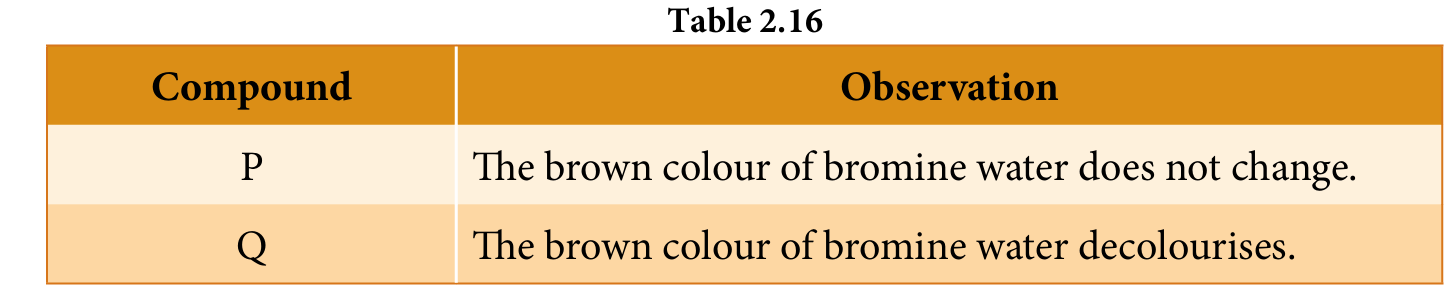
Based on Table 2.16, explain the differences in these observations.
(b) 2.3 g of compound R burns completely in excess oxygen to produce carbon dioxide gas and water. Write the chemical equation for the reaction and determine the volume of carbon dioxide gas produced. [Molar mass R = 46 g mol−1, molar volume of the gas at room condition = 24 dm3 mol−1].
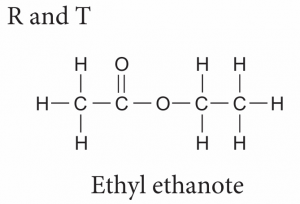
(c) State two compounds from Table 2.16 that react to produce ester.
Name and draw the structural formula for the ester formed.
(d) Acid X is used as a catalyst during the esterification reaction. When the concentrated acid X is spilt on the marble floor, gas bubbles are formed. Name acid X and write the chemical equation for the reaction.
Answer:
(a)(i)
– Q burns with more soot than P
– Percentage of carbon by mass in molecules P and Q:
$$ \begin{aligned} &\% C \text { in } P=\frac{3(12)}{3(12)+8(1)} \times 100 \%=81.8 \%\\ &\% C \text { in } Q=\frac{3(12)}{3(12)+6(1)} \times 100 \%=85.7 \% \end{aligned} $$
– The percentage of carbon by mass in molecule Q is higher. Therefore, Q burns with more soot than P.
(ii) – P is a saturated hydrocarbon that only has a single bond between carbon atoms. Addition reaction does
not occur between compound P and bromine water.
– Q is an unsaturated hydrocarbon that has a double bond between carbon atoms. Addition reaction occurs between molecules Q and bromine water:
C3H6 + Br2 → C3H6Br2
(b)
$$ \begin{aligned} &\mathrm{C}_2 \mathrm{H}_5 \mathrm{OH}+3 \mathrm{O}_2 \rightarrow 4 \mathrm{CO}_2+3 \mathrm{H}_2 \mathrm{O}\\ &\text { Mol of } \mathrm{R}=\frac{2.3 \mathrm{~g}}{46 \mathrm{~g} \mathrm{~mol}^{-1}}=0.05 \mathrm{~mol} \end{aligned} $$
$$ \begin{aligned} & \text { From the equation: } \quad 1 \mathrm{~mol} \mathrm{C}_2 \mathrm{H}_5 \mathrm{OH} \mathrm{:} 2 \mathrm{~mol} \mathrm{CO}_2 \\ & \quad 0.05 \mathrm{~mol} \mathrm{C}_2 \mathrm{H}_5 \mathrm{OH}: 0.10 \mathrm{~mol} \mathrm{CO}_2 \\ & \begin{aligned} \text { Volume of } \mathrm{CO}_2= & 0.10 \mathrm{~mol} \times 24 \mathrm{dm}^3 \mathrm{~mol}^{-1} \\ = & 2.4 \mathrm{dm}^3 \end{aligned} \end{aligned} $$
(c)
(d) Acid X is concentrated sulphuric acid
Chemical equation:
2H2SO4 + CaCO3 → CaSO4 + H2O + CO2
Table 2.15 shows carbon compounds and their respective molecular formulae.

(a)(i) Compare and contrast the sootiness of flames of compound P and compound Q when burnt in excess oxygen. Explain your answer.
[Relative atomic mass: C = 12, H = 1].
(ii) Table 2.16 shows the result of an experiment where compound P and compound Q were separately shaken in bromine water in test tubes.

Based on Table 2.16, explain the differences in these observations.
(b) 2.3 g of compound R burns completely in excess oxygen to produce carbon dioxide gas and water. Write the chemical equation for the reaction and determine the volume of carbon dioxide gas produced. [Molar mass R = 46 g mol−1, molar volume of the gas at room condition = 24 dm3 mol−1].
(c) State two compounds from Table 2.16 that react to produce ester.
Name and draw the structural formula for the ester formed.
(d) Acid X is used as a catalyst during the esterification reaction. When the concentrated acid X is spilt on the marble floor, gas bubbles are formed. Name acid X and write the chemical equation for the reaction.
Answer:
(a)(i)
– Q burns with more soot than P
– Percentage of carbon by mass in molecules P and Q:
$$ \begin{aligned} &\% C \text { in } P=\frac{3(12)}{3(12)+8(1)} \times 100 \%=81.8 \%\\ &\% C \text { in } Q=\frac{3(12)}{3(12)+6(1)} \times 100 \%=85.7 \% \end{aligned} $$
– The percentage of carbon by mass in molecule Q is higher. Therefore, Q burns with more soot than P.
(ii) – P is a saturated hydrocarbon that only has a single bond between carbon atoms. Addition reaction does
not occur between compound P and bromine water.
– Q is an unsaturated hydrocarbon that has a double bond between carbon atoms. Addition reaction occurs between molecules Q and bromine water:
C3H6 + Br2 → C3H6Br2
(b)
$$ \begin{aligned} &\mathrm{C}_2 \mathrm{H}_5 \mathrm{OH}+3 \mathrm{O}_2 \rightarrow 4 \mathrm{CO}_2+3 \mathrm{H}_2 \mathrm{O}\\ &\text { Mol of } \mathrm{R}=\frac{2.3 \mathrm{~g}}{46 \mathrm{~g} \mathrm{~mol}^{-1}}=0.05 \mathrm{~mol} \end{aligned} $$
$$ \begin{aligned} & \text { From the equation: } \quad 1 \mathrm{~mol} \mathrm{C}_2 \mathrm{H}_5 \mathrm{OH} \mathrm{:} 2 \mathrm{~mol} \mathrm{CO}_2 \\ & \quad 0.05 \mathrm{~mol} \mathrm{C}_2 \mathrm{H}_5 \mathrm{OH}: 0.10 \mathrm{~mol} \mathrm{CO}_2 \\ & \begin{aligned} \text { Volume of } \mathrm{CO}_2= & 0.10 \mathrm{~mol} \times 24 \mathrm{dm}^3 \mathrm{~mol}^{-1} \\ = & 2.4 \mathrm{dm}^3 \end{aligned} \end{aligned} $$
(c)

(d) Acid X is concentrated sulphuric acid
Chemical equation:
2H2SO4 + CaCO3 → CaSO4 + H2O + CO2