Question 1:
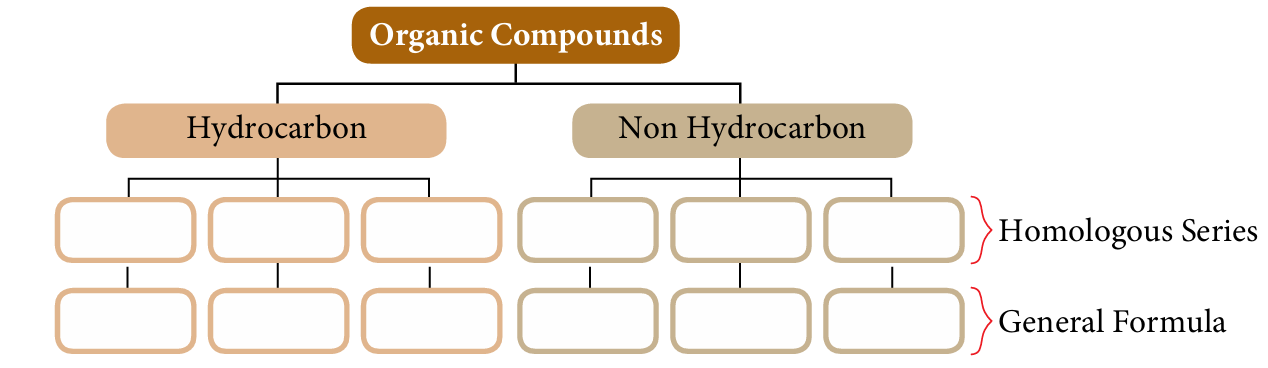
Complete the following tree map with respective homologous series and general formula.
Answer:
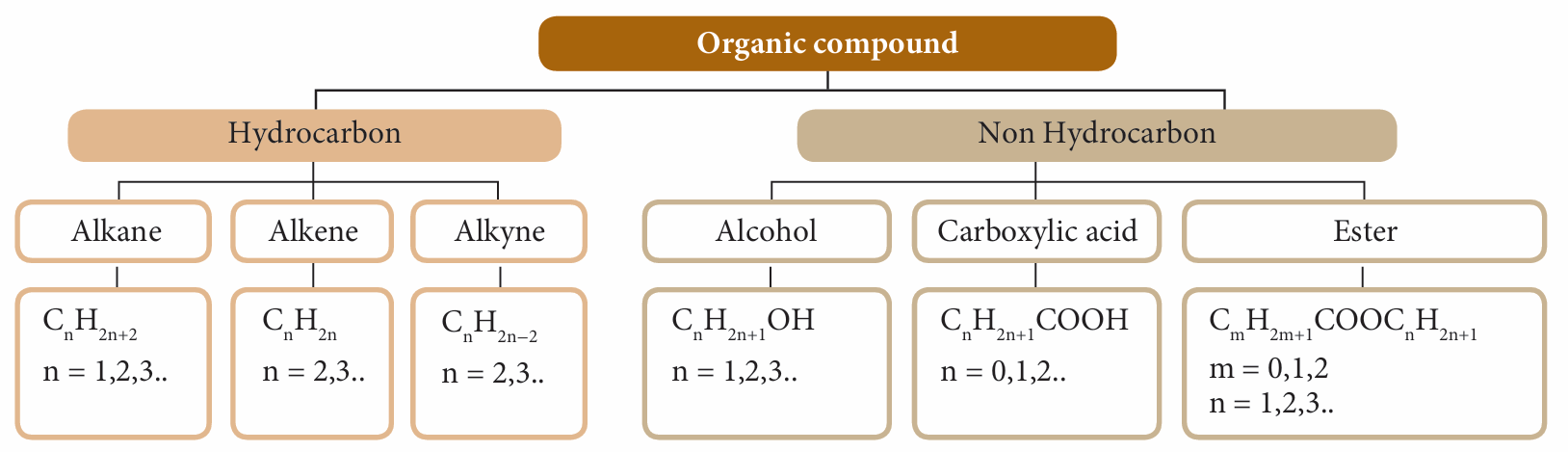
Complete the following tree map with respective homologous series and general formula.

Answer:

Question 2:
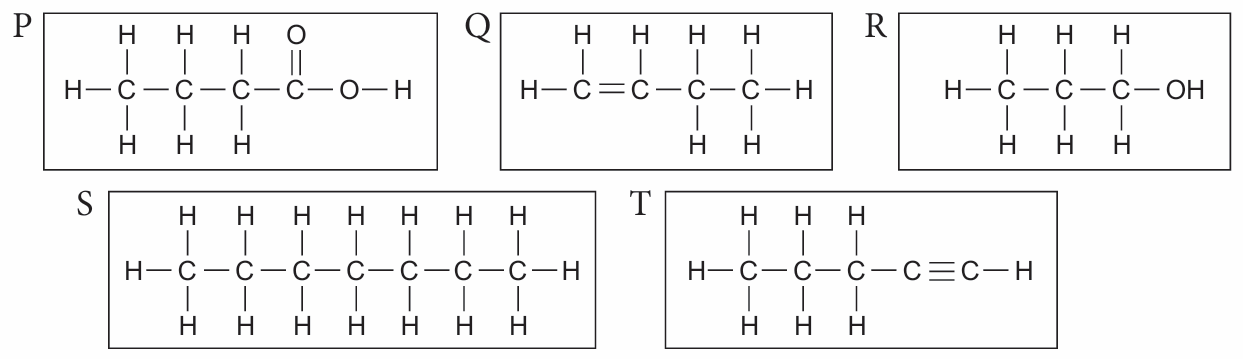
Table 2.13 shows the molecular formula of organic compounds P, Q, R, S and T from different homologous series.

(a) For all compounds in the table above:
(i) state their homologous series,
(ii) draw the structural formula,
(iii) write their IUPAC names.
(b) List all compounds that exist in the form of:
(i) gas at room temperature.
(ii) liquid at room temperature.
(c) List all compounds that:
(i) dissolve in water.
(ii) do not dissolve in water.
(d) Compare the boiling points of compounds Q and S. Explain your answer.
Answer:
(a)(i)

(a)(ii)
(a)(iii)

(b) (i) Substance that exists in the form of gas: Q
(ii) Substances that exist in the form of liquid: P, R, S and T
(c) (i) P and R
(ii) Q, S and T
(d) – Boiling point of S is higher than Q.
– The molecular size of S is larger than Q
– The van der Waals forces between S molecules are stronger than Q.
– More energy is needed to overcome the attraction between S molecules compared to Q molecules.
Table 2.13 shows the molecular formula of organic compounds P, Q, R, S and T from different homologous series.

(a) For all compounds in the table above:
(i) state their homologous series,
(ii) draw the structural formula,
(iii) write their IUPAC names.
(b) List all compounds that exist in the form of:
(i) gas at room temperature.
(ii) liquid at room temperature.
(c) List all compounds that:
(i) dissolve in water.
(ii) do not dissolve in water.
(d) Compare the boiling points of compounds Q and S. Explain your answer.
Answer:
(a)(i)

(a)(ii)

(a)(iii)

(b) (i) Substance that exists in the form of gas: Q
(ii) Substances that exist in the form of liquid: P, R, S and T
(c) (i) P and R
(ii) Q, S and T
(d) – Boiling point of S is higher than Q.
– The molecular size of S is larger than Q
– The van der Waals forces between S molecules are stronger than Q.
– More energy is needed to overcome the attraction between S molecules compared to Q molecules.