Laboratory Activity 2C (Chemical Properties of Ethanol):
Aim: To study the chemical properties of ethanol, C2H5OH.
Materials: Ethanol, C2H5OH, porcelain chips, glass wool, potassium dichromate(VI), K2Cr2O7 solution, potassium manganate(VII), KMnO4 solution, concentrated sulphuric acid, H2SO4, blue litmus paper, bromine water, Br2.
Apparatus:
Test tube, boiling tube, boiling tube stopper with delivery tube, retort stand, test tube holder, Bunsen burner, measuring cylinder, dropper and beaker.
A. Oxidation of Ethanol, C2H5OH
Procedure:
1. Pour 5 cm3 of potassium dichromate(VI), K2Cr2O7 solution into a boiling tube.
2. Add 10 drops of concentrated sulphuric acid, H2SO4.
3. Gently heat the solution.
4. Add 3 cm3 of ethanol, C2H5OH drop by drop into the boiling tube.
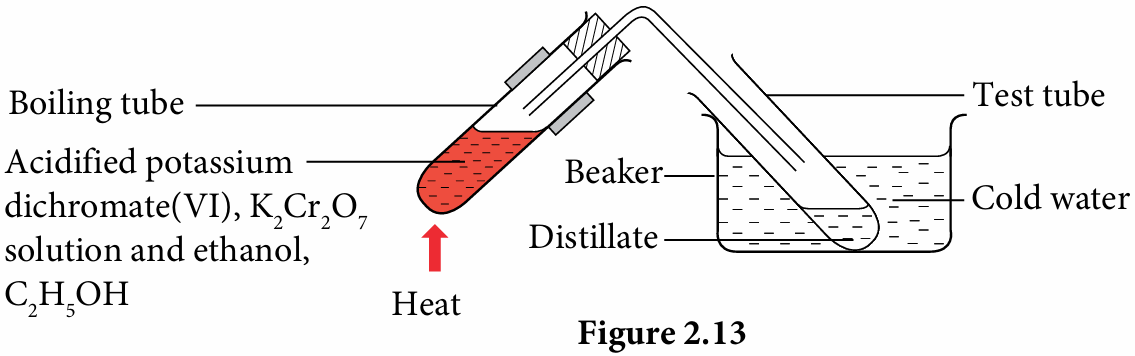
5. Connect the delivery tube to the boiling tube as shown in Figure 2.13. Heat the mixture with a gentle flame until the mixture boils.
6. Collect the distillate in a test tube and test it with the blue litmus paper.
7. Repeat steps 1 to 6 by replacing potassium dichromate(VI), K2Cr2O7 solution with potassium manganate(VII), KMnO4 solution.
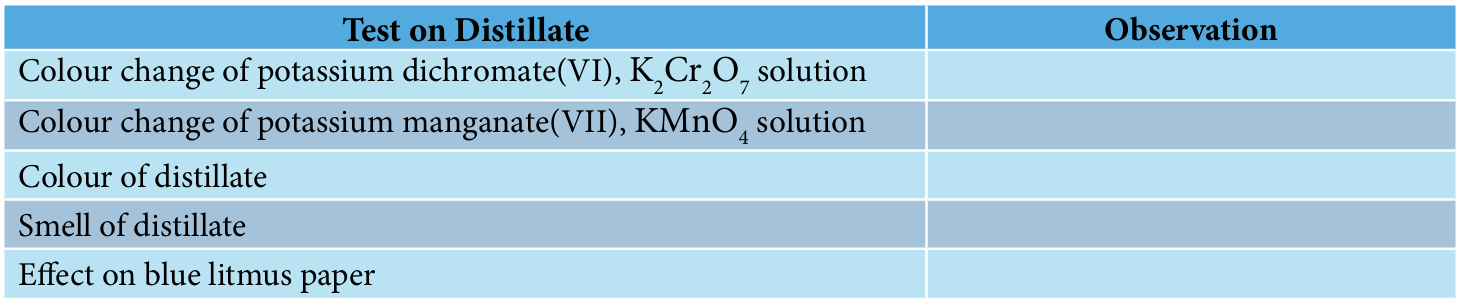
Observation:
Discussion:
1. What is the product formed by the oxidation reaction of ethanol, C2H5OH?
2. Name the oxidising agent used in this experiment.
3. Write the chemical equation of the reaction that occurs.
4. What is the property of the product of alcohol oxidation?
Conclusion:
The oxidation of ethanol, C2H5OH produces ethanoic acid, CH3COOH.
B. Dehydration of Ethanol, C2H5OH
Procedure:
1. Place the glass wool in a boiling tube.
2. Pour 2 cm3 of ethanol, C2H5OH into the boiling tube to wet the glass wool.
3. Place the porcelain chips in the middle of the boiling tube as shown in Figure 2.14.
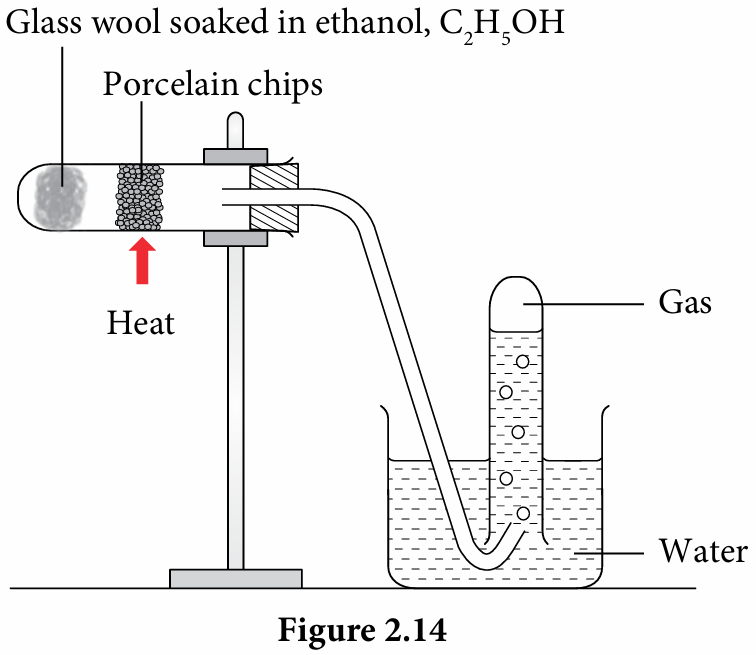
4. Heat the porcelain chips with a strong flame. Heat the glass wool with a gentle flame to vaporise the ethanol, C2H5OH and the vapour is flowed through the heated porcelain chips.
5. Collect two test tubes of the gas released, as shown in Figure 2.14.
6. (i) Add a few drops of bromine water, Br2 into the first test tube and shake.
(ii) Add a few drops of acidified potassium manganate(VII ), KMnO4 solution into the second test tube and shake.
Observation:

Discussion:
1. Name the gas released when ethanol, C2H5OH undergoes dehydration.
2. State the function of porcelain chips.
3. Write the chemical equation for the dehydration of alcohol, C2H5OH.
Conclusion:
Dehydration of ethanol, C2H5OH produces ethene, C2H4.
Answer:
A: Oxidation of ethanol
1. Ethanoic acid
2. 1. Potassium dichromate(VI) solution
2. Potassium manganate (VII) solution
3.
$$ \underset{\text { Ethanol }}{\mathrm{C}_2 \mathrm{H}_5 \mathrm{OH}}+2[\mathrm{O}] \rightarrow \quad \underset{\text { Ethanoic acid }}{\mathrm{CH}_3 \mathrm{COOH}}+\underset{\text { Water }}{\mathrm{H}_2 \mathrm{O}} $$
4. Acidic
B: Dehydration of ethanol
1. Ethene
2. As a catalyst
3.
$$ \underset{\text { Ethanol }}{\mathrm{C}_2 \mathrm{H}_5 \mathrm{OH}} \xrightarrow{\text { Porcelain chips }} \underset{\text { Ethene }}{\mathrm{C}_2 \mathrm{H}_4} \quad+\quad \underset{\text { Water }}{\mathrm{H}_2 \mathrm{O}} $$
Aim: To study the chemical properties of ethanol, C2H5OH.
Materials: Ethanol, C2H5OH, porcelain chips, glass wool, potassium dichromate(VI), K2Cr2O7 solution, potassium manganate(VII), KMnO4 solution, concentrated sulphuric acid, H2SO4, blue litmus paper, bromine water, Br2.
Apparatus:
Test tube, boiling tube, boiling tube stopper with delivery tube, retort stand, test tube holder, Bunsen burner, measuring cylinder, dropper and beaker.
A. Oxidation of Ethanol, C2H5OH

Procedure:
1. Pour 5 cm3 of potassium dichromate(VI), K2Cr2O7 solution into a boiling tube.
2. Add 10 drops of concentrated sulphuric acid, H2SO4.
3. Gently heat the solution.
4. Add 3 cm3 of ethanol, C2H5OH drop by drop into the boiling tube.
5. Connect the delivery tube to the boiling tube as shown in Figure 2.13. Heat the mixture with a gentle flame until the mixture boils.
6. Collect the distillate in a test tube and test it with the blue litmus paper.
7. Repeat steps 1 to 6 by replacing potassium dichromate(VI), K2Cr2O7 solution with potassium manganate(VII), KMnO4 solution.
Observation:

Discussion:
1. What is the product formed by the oxidation reaction of ethanol, C2H5OH?
2. Name the oxidising agent used in this experiment.
3. Write the chemical equation of the reaction that occurs.
4. What is the property of the product of alcohol oxidation?
Conclusion:
The oxidation of ethanol, C2H5OH produces ethanoic acid, CH3COOH.
B. Dehydration of Ethanol, C2H5OH
Procedure:
1. Place the glass wool in a boiling tube.
2. Pour 2 cm3 of ethanol, C2H5OH into the boiling tube to wet the glass wool.
3. Place the porcelain chips in the middle of the boiling tube as shown in Figure 2.14.

4. Heat the porcelain chips with a strong flame. Heat the glass wool with a gentle flame to vaporise the ethanol, C2H5OH and the vapour is flowed through the heated porcelain chips.
5. Collect two test tubes of the gas released, as shown in Figure 2.14.
6. (i) Add a few drops of bromine water, Br2 into the first test tube and shake.
(ii) Add a few drops of acidified potassium manganate(VII ), KMnO4 solution into the second test tube and shake.
Observation:

Discussion:
1. Name the gas released when ethanol, C2H5OH undergoes dehydration.
2. State the function of porcelain chips.
3. Write the chemical equation for the dehydration of alcohol, C2H5OH.
Conclusion:
Dehydration of ethanol, C2H5OH produces ethene, C2H4.
Answer:
A: Oxidation of ethanol
1. Ethanoic acid
2. 1. Potassium dichromate(VI) solution
2. Potassium manganate (VII) solution
3.
$$ \underset{\text { Ethanol }}{\mathrm{C}_2 \mathrm{H}_5 \mathrm{OH}}+2[\mathrm{O}] \rightarrow \quad \underset{\text { Ethanoic acid }}{\mathrm{CH}_3 \mathrm{COOH}}+\underset{\text { Water }}{\mathrm{H}_2 \mathrm{O}} $$
4. Acidic
B: Dehydration of ethanol
1. Ethene
2. As a catalyst
3.
$$ \underset{\text { Ethanol }}{\mathrm{C}_2 \mathrm{H}_5 \mathrm{OH}} \xrightarrow{\text { Porcelain chips }} \underset{\text { Ethene }}{\mathrm{C}_2 \mathrm{H}_4} \quad+\quad \underset{\text { Water }}{\mathrm{H}_2 \mathrm{O}} $$