Laboratory Activity 2B (Preparation of Ethanol, C2H5OH Through Fermentation of Glucose):
Aim: To prepare ethanol, C2H5OH through fermentation of glucose.
Materials: Glucose, C6H12O6, yeast, limewater, distilled water and filter paper.
Apparatus: Conical flask, beaker, measuring cylinder, round-bottom flask, delivery tube, stopper, test tube, thermometer, fractionating column, Liebig condenser, retort stand, wire gauze, Bunsen burner, tripod stand, rubber tubing, filter funnel and glass rod.
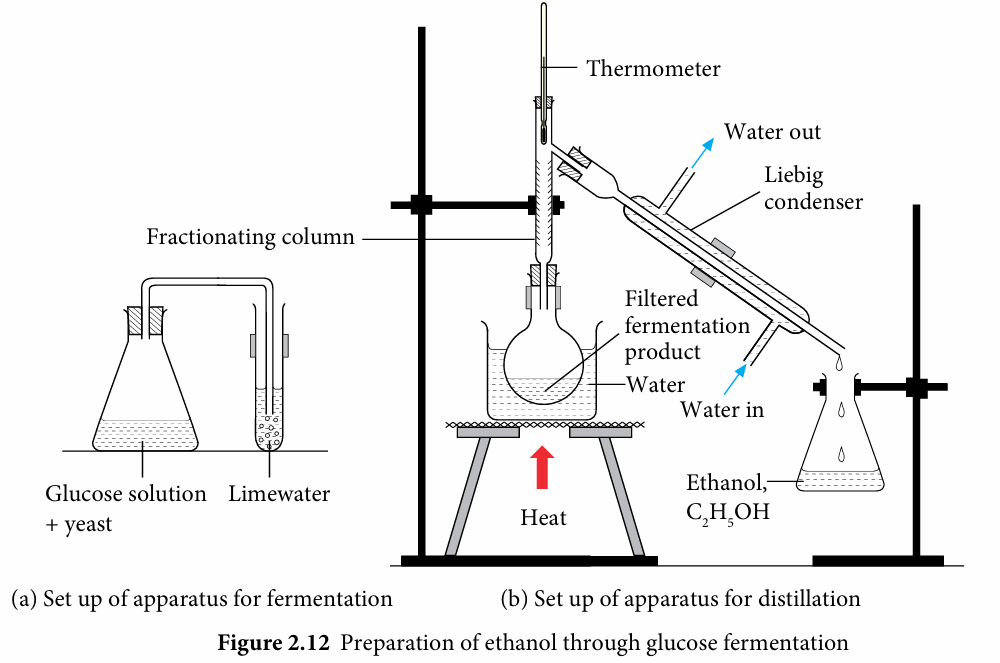
Procedure:
1. Put 20 g of glucose, C6H12O6 into 200 cm3 of distilled water into a conical flask.
2. Add 10 g of yeast into the conical flask and stir with a glass rod until the mixture is even.
3. Close the conical flask with a stopper connected to the delivery tube.
4. Insert the end of the delivery tube into the test tube as shown in Figure 2.12.
Make sure the end of the delivery tube is dipped into the limewater.
5. Place the apparatus at room temperature (30 °C) for three days.
6. After three days, filter the mixture from the conical flask.
7. The filtrate is poured into a round-bottom flask. The apparatus for distillation is set up as shown in Figure 2.12.
8. Heat the filtrate in the water bath and collect the distillate at 78 °C.
9. Record the colour and smell of the distillate.
Observation:
Construct a table to record your observations.
Discussion:
1. What is the function of yeast in the fermentation of glucose, C6H12O6?
2. Why must the end of the delivery tube be immersed in limewater?
3. Name the gas released in the fermentation of glucose, C6H12O6.
4. Name the product collected in fractional distillation at 78 °C.
5. Explain why ethanol, C2H5OH from the filtrate can be separated at 78 °C.
6. Write the chemical equation for the fermentation of glucose, C6H12O6.
7. Fermentation to produce ethanol, C2H5OH can also be carried out using fruits. Explain why.
Results:
1. Ethanol, C2H5OH can be prepared through the fermentation of glucose, C6H12O6.
2. Ethanol, C2H5OH is a colourless and volatile liquid at room temperature.
Answer:
1. Yeast contains enzymes that act as a catalyst to break down glucose into ethanol and carbon dioxide.
2. To ensure that the gas released during fermentation is passed through the lime water.
3. Carbon dioxide gas
4. Ethanol
5. – The filtrate is a mixture of ethanol and water that have different boiling points. The boiling point of ethanol is lower than that of water.
– When the mixture is heated, ethanol boils first before water at the temperature of 78 °C.
– The ethanol vapour formed at its boiling point will be condensed in a Liebig condenser and then collected in a test tube.
6.
$$ \underset{\text { Glucose }}{\mathrm{C}_6 \mathrm{H}_{12} \mathrm{O}_6(\mathrm{ce})} \xrightarrow{\text { Yeast }} \underset{\text { Ethanol }}{2 \mathrm{C}_2 \mathrm{H}_5 \mathrm{OH}(\mathrm{ce})}+2 \mathrm{CO}_2(\mathrm{~g}) $$
7. Fruits contain carbohydrates, such as glucose, fructose and sucrose. During fermentation, yeasts that contain the enzyme zymase break down the molecules of these carbohydrates to produce ethanol.
Aim: To prepare ethanol, C2H5OH through fermentation of glucose.
Materials: Glucose, C6H12O6, yeast, limewater, distilled water and filter paper.
Apparatus: Conical flask, beaker, measuring cylinder, round-bottom flask, delivery tube, stopper, test tube, thermometer, fractionating column, Liebig condenser, retort stand, wire gauze, Bunsen burner, tripod stand, rubber tubing, filter funnel and glass rod.

Procedure:
1. Put 20 g of glucose, C6H12O6 into 200 cm3 of distilled water into a conical flask.
2. Add 10 g of yeast into the conical flask and stir with a glass rod until the mixture is even.
3. Close the conical flask with a stopper connected to the delivery tube.
4. Insert the end of the delivery tube into the test tube as shown in Figure 2.12.
Make sure the end of the delivery tube is dipped into the limewater.
5. Place the apparatus at room temperature (30 °C) for three days.
6. After three days, filter the mixture from the conical flask.
7. The filtrate is poured into a round-bottom flask. The apparatus for distillation is set up as shown in Figure 2.12.
8. Heat the filtrate in the water bath and collect the distillate at 78 °C.
9. Record the colour and smell of the distillate.
Observation:
Construct a table to record your observations.
Discussion:
1. What is the function of yeast in the fermentation of glucose, C6H12O6?
2. Why must the end of the delivery tube be immersed in limewater?
3. Name the gas released in the fermentation of glucose, C6H12O6.
4. Name the product collected in fractional distillation at 78 °C.
5. Explain why ethanol, C2H5OH from the filtrate can be separated at 78 °C.
6. Write the chemical equation for the fermentation of glucose, C6H12O6.
7. Fermentation to produce ethanol, C2H5OH can also be carried out using fruits. Explain why.
Results:
1. Ethanol, C2H5OH can be prepared through the fermentation of glucose, C6H12O6.
2. Ethanol, C2H5OH is a colourless and volatile liquid at room temperature.
Answer:
1. Yeast contains enzymes that act as a catalyst to break down glucose into ethanol and carbon dioxide.
2. To ensure that the gas released during fermentation is passed through the lime water.
3. Carbon dioxide gas
4. Ethanol
5. – The filtrate is a mixture of ethanol and water that have different boiling points. The boiling point of ethanol is lower than that of water.
– When the mixture is heated, ethanol boils first before water at the temperature of 78 °C.
– The ethanol vapour formed at its boiling point will be condensed in a Liebig condenser and then collected in a test tube.
6.
$$ \underset{\text { Glucose }}{\mathrm{C}_6 \mathrm{H}_{12} \mathrm{O}_6(\mathrm{ce})} \xrightarrow{\text { Yeast }} \underset{\text { Ethanol }}{2 \mathrm{C}_2 \mathrm{H}_5 \mathrm{OH}(\mathrm{ce})}+2 \mathrm{CO}_2(\mathrm{~g}) $$
7. Fruits contain carbohydrates, such as glucose, fructose and sucrose. During fermentation, yeasts that contain the enzyme zymase break down the molecules of these carbohydrates to produce ethanol.