Question 1:
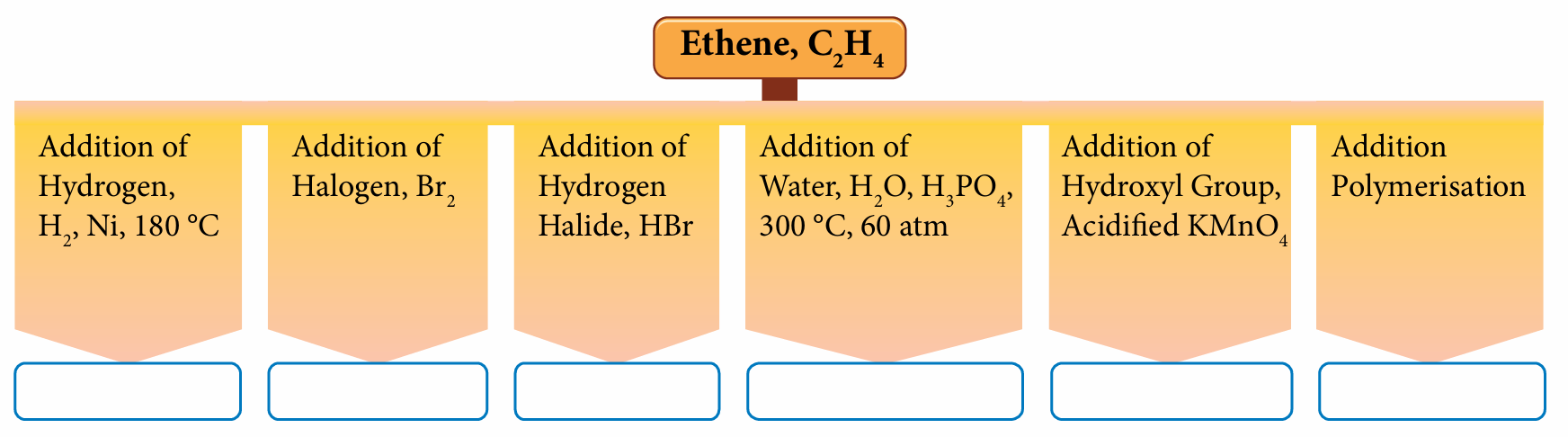
Copy and complete the tree map by writing the chemical equation for each addition reaction that occurs on ethene, C2H4.
Answer:
$$ \begin{aligned} &\text { Addition of hydrogen: }\\ &\mathrm{C}_2 \mathrm{H}_4+\mathrm{H}_2 \rightarrow \mathrm{C}_2 \mathrm{H}_6 \end{aligned} $$
$$ \begin{aligned} &\text { Addition of halogen, } \mathrm{Br}_2 \text { : }\\ &\mathrm{C}_2 \mathrm{H}_4+\mathrm{Br}_2 \rightarrow \mathrm{C}_2 \mathrm{H}_4 \mathrm{Br}_2 \end{aligned} $$
$$ \begin{aligned} &\text { Addition of hydrogen halide, } \mathrm{HBr} \text { : }\\ &\mathrm{C}_2 \mathrm{H}_4+\mathrm{HBr} \rightarrow \mathrm{C}_2 \mathrm{H}_5 \mathrm{Br} \end{aligned} $$
$$ \begin{aligned} &\text { Addition of water (Hydration): }\\ &\mathrm{C}_2 \mathrm{H}_4+\mathrm{H}_2 \mathrm{O} \xrightarrow[300^{\circ} \mathrm{C}, 60 \mathrm{~atm}]{\mathrm{H}_3 \mathrm{PO}_4} \mathrm{C}_2 \mathrm{H}_5 \mathrm{OH} \end{aligned} $$
$$ \begin{aligned} &\text { Addition of hydroxyl group, acidified } \mathrm{KMnO}_4 \text { : }\\ &\mathrm{C}_2 \mathrm{H}_4(\mathrm{~g})+\mathrm{H}_2 \mathrm{O}+[\mathrm{O}] \longrightarrow \mathrm{C}_2 \mathrm{H}_4(\mathrm{OH})_2 \end{aligned} $$
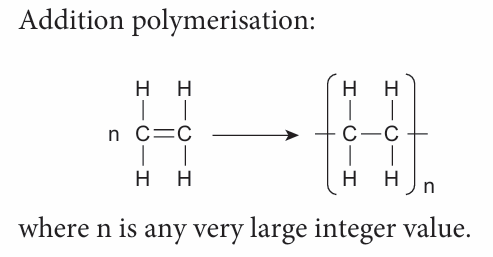
Copy and complete the tree map by writing the chemical equation for each addition reaction that occurs on ethene, C2H4.

Answer:
$$ \begin{aligned} &\text { Addition of hydrogen: }\\ &\mathrm{C}_2 \mathrm{H}_4+\mathrm{H}_2 \rightarrow \mathrm{C}_2 \mathrm{H}_6 \end{aligned} $$
$$ \begin{aligned} &\text { Addition of halogen, } \mathrm{Br}_2 \text { : }\\ &\mathrm{C}_2 \mathrm{H}_4+\mathrm{Br}_2 \rightarrow \mathrm{C}_2 \mathrm{H}_4 \mathrm{Br}_2 \end{aligned} $$
$$ \begin{aligned} &\text { Addition of hydrogen halide, } \mathrm{HBr} \text { : }\\ &\mathrm{C}_2 \mathrm{H}_4+\mathrm{HBr} \rightarrow \mathrm{C}_2 \mathrm{H}_5 \mathrm{Br} \end{aligned} $$
$$ \begin{aligned} &\text { Addition of water (Hydration): }\\ &\mathrm{C}_2 \mathrm{H}_4+\mathrm{H}_2 \mathrm{O} \xrightarrow[300^{\circ} \mathrm{C}, 60 \mathrm{~atm}]{\mathrm{H}_3 \mathrm{PO}_4} \mathrm{C}_2 \mathrm{H}_5 \mathrm{OH} \end{aligned} $$
$$ \begin{aligned} &\text { Addition of hydroxyl group, acidified } \mathrm{KMnO}_4 \text { : }\\ &\mathrm{C}_2 \mathrm{H}_4(\mathrm{~g})+\mathrm{H}_2 \mathrm{O}+[\mathrm{O}] \longrightarrow \mathrm{C}_2 \mathrm{H}_4(\mathrm{OH})_2 \end{aligned} $$

Question 2:
Hexane, C6H14 and hexene, C6H12 are colourless liquids.
(a) State the difference in observations when both liquids are burnt in excess oxygen. Explain why the differences occur.
(b) Other than combustion, describe a chemical test that can be used to distinguish these two liquids.
Answer:
(a)
– $$ \begin{aligned} &\text { Hexene burns with more soot than hexane. }\\ &\begin{aligned} & \% C \text { in hexane }=\frac{6(12)}{6(12)+14(1)} \times 100 \%=83.72 \% \\ & \% C \text { in hexene }=\frac{6(12)}{6(12)+12(1)} \times 100 \%=85.71 \% \end{aligned} \end{aligned} $$
– The percentage of carbon by mass in hexene is higher than hexane.
(b)
1. Put 2 cm3 of hexane into the test tube.
2. Add 2 – 3 drops of bromine water in 1,1,1-trichloroethane into hexane.
3. Shake the mixture.
4. Record all observations.
5. Steps 1 to 4 are repeated using hexene to replace hexane.
Observation:
– Hexene decolourises the brown colour of bromine water.
– Hexane does not decolourise the brown colour of bromine water.
Hexane, C6H14 and hexene, C6H12 are colourless liquids.
(a) State the difference in observations when both liquids are burnt in excess oxygen. Explain why the differences occur.
(b) Other than combustion, describe a chemical test that can be used to distinguish these two liquids.
Answer:
(a)
– $$ \begin{aligned} &\text { Hexene burns with more soot than hexane. }\\ &\begin{aligned} & \% C \text { in hexane }=\frac{6(12)}{6(12)+14(1)} \times 100 \%=83.72 \% \\ & \% C \text { in hexene }=\frac{6(12)}{6(12)+12(1)} \times 100 \%=85.71 \% \end{aligned} \end{aligned} $$
– The percentage of carbon by mass in hexene is higher than hexane.
(b)
1. Put 2 cm3 of hexane into the test tube.
2. Add 2 – 3 drops of bromine water in 1,1,1-trichloroethane into hexane.
3. Shake the mixture.
4. Record all observations.
5. Steps 1 to 4 are repeated using hexene to replace hexane.
Observation:
– Hexene decolourises the brown colour of bromine water.
– Hexane does not decolourise the brown colour of bromine water.