Laboratory Activity 3B (Determining Heat of Precipitation):
Aim: To determine the heat of precipitation of silver chloride, AgCl and magnesium carbonate, MgCO3.
Materials: 0.5 mol dm−3 of silver nitrate, AgNO3 solution, 0.5 mol dm−3 of sodium chloride, NaCl solution, 0.5 mol dm−3 of magnesium nitrate, Mg(NO3)2 solution and 0.5 mol dm−3 of sodium carbonate, Na2CO3 solution.
Apparatus: Two polystyrene cups with lids, measuring cylinder and thermometer.
Operational definition – Heat of Precipitation: when sodium chloride, NaCl solution is added to silver nitrate, AgNO3 solution to produce 1 mole of silver chloride, AgCl precipitate, the thermometer reading increases.
Procedure:
1. Measure 25 cm3 of 0.5 mol dm−3 of silver nitrate, AgNO3 solution and pour it into a polystyrene cup.
2. Put a thermometer into the solution and leave aside for two minutes.
3. Record the temperature of the solution.
4. Measure 25 cm3 of 0.5 mol dm−3 of sodium chloride, NaCl solution, and pour it into another polystyrene cup.
5. Put a thermometer into the solution and leave it aside for two minutes. Record the temperature of the solution.
6. Pour the sodium chloride, NaCl solution quickly and carefully into the polystyrene cup containing the silver nitrate, AgNO3 solution.
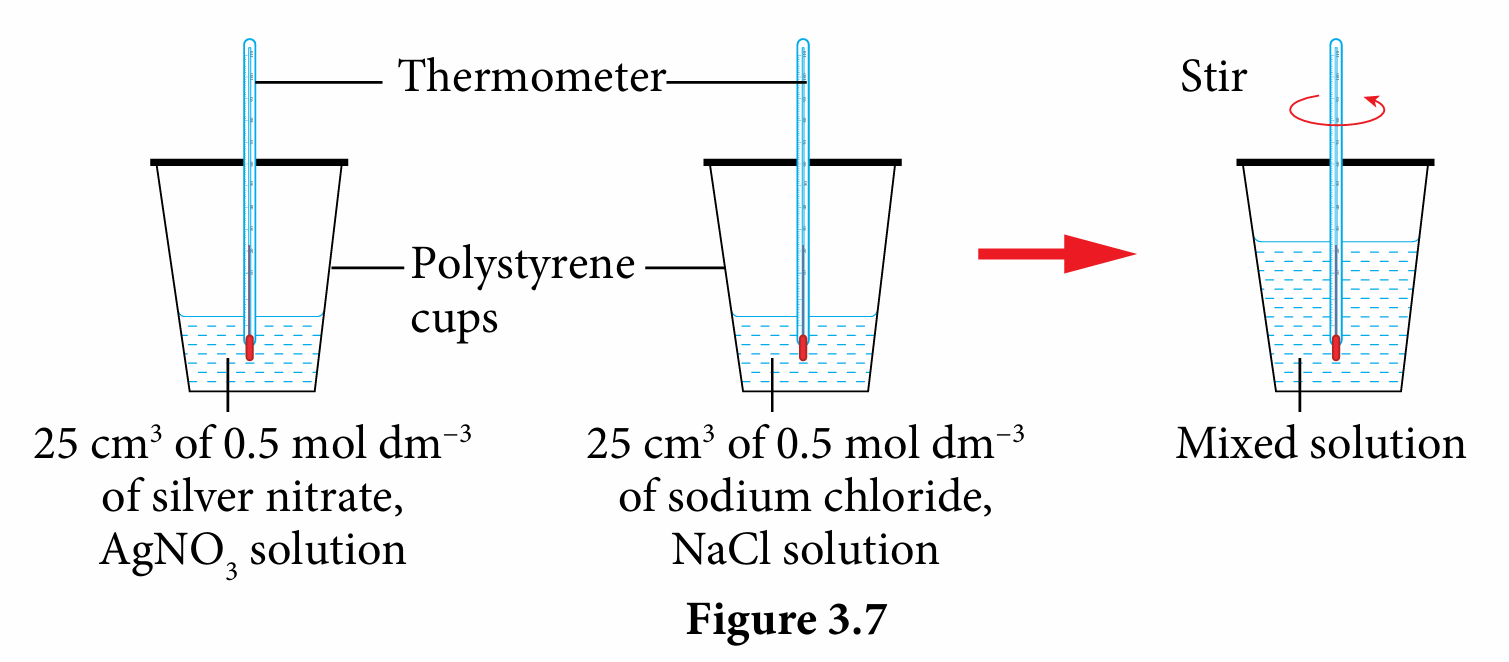
7. Cover the polystyrene cup and stir the mixture using the thermometer as shown in Figure 3.7.
8. Record the highest temperature of the mixture.
9. Repeat steps 1 to 8 by replacing silver nitrate, AgNO3 solution with magnesium nitrate, Mg(NO3)2 solution, and sodium chloride, NaCl solution with sodium carbonate, Na2CO3 solution.
Results:
Construct a suitable table to record your results and observations.
Discussion:
1. State the type of reaction that occurred.
2. Calculate the heat of precipitation of silver chloride, AgCl and magnesium carbonate, MgCO3
[Use the heat change formula, Q = mcθ]
[Given: Specific heat capacity of solution, c = 4.2 J g−1 °C−1; density of solution = 1 g cm−3]
3. Write the thermochemical equation for the precipitation of silver chloride, AgCl and magnesium carbonate, MgCO3.
4. Construct the energy level diagram for the precipitation of silver chloride, AgCl and magnesium carbonate, MgCO3.
5. The theoretical value for the heat of precipitation of silver chloride, AgCl is -65.5 kJ mol−1.
Is this value the same as the value obtained in this experiment? Explain your answer.
Conclusion:
What is the conclusion that can be drawn from this experiment?
Answer:
Result:
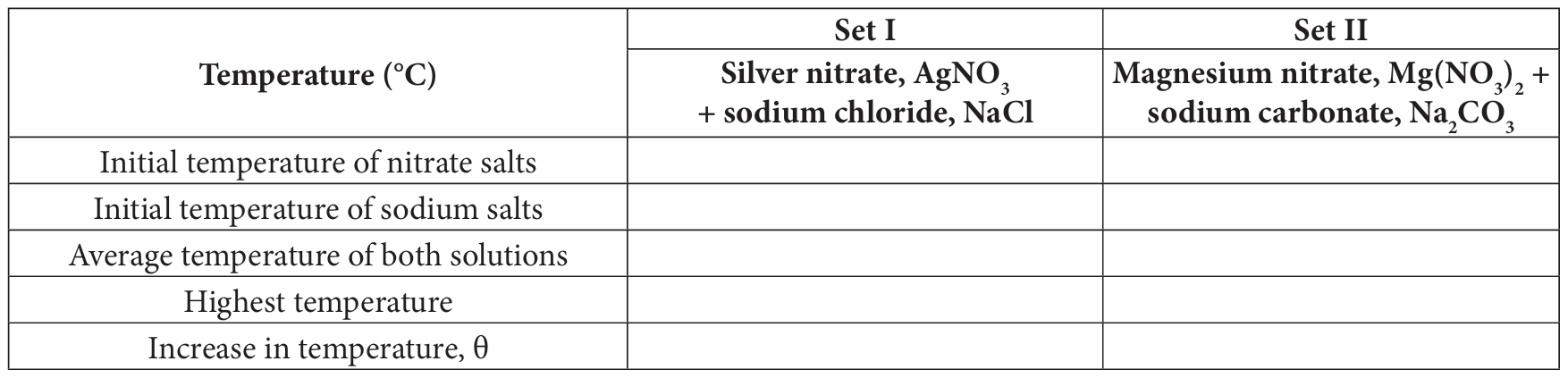
Discussions:
1. Double decomposition reaction (Precipitation reaction)
2. Steps in calculations:
(a) Heat of precipitation of silver chloride
(i) Calculate the number of moles or silver chloride, AgCl precipitate formed
$$ \begin{aligned} &\text { Number of moles of silver ions, } \mathrm{Ag}^{+}=\text {number of moles of silver nitrate, } \mathrm{AgNO}_3\\ &=0.5 \mathrm{~mol} \mathrm{dm} \mathrm{~m}^{-3} \times \frac{25}{1000} \mathrm{dm}^3=0.0125 \mathrm{~mol} \end{aligned} $$
$$ \begin{aligned} &\text { Number of moles of chloride ions, } \mathrm{Cl}^{-}=\text {number of moles of sodium chloride, } \mathrm{NaCl} \text { solution }\\ &=0.5 \mathrm{~mol} \mathrm{dm}^{-3} \times \frac{25}{1000} \mathrm{dm}^3=0.0125 \mathrm{~mol} \end{aligned} $$
Ionic equation: Ag+(aq) + Cl−(aq) → AgCl(s)
From the ionic equation. 1 mole of silver ions, Ag+ reacts with 1 mole of chloride ions, ,Cl− to produce 1 mole of silver chloride, AgCl.
Therefore, 0.0125 moles of silver ions, Ag+ reacts with 0.0125 moles of chloride ions, Cl− to produce 0.0125 moles of silver chloride, AgCl.
(ii) Calculate the heat change:
Mass of reacting mixture = Total volume of reacting mixture × density of solution
= (25 + 25)cm3 × 1 g cm−3 = 200 g
Change in temperature of mixture, θ = Highest temperature − lowest temperature
Heat released in the reaction Q = mcθ
= 200 g × 4.2 J g−1 °C−1 × θ
= x J
(iii) Calculate the heat change for the formation of 1 mole of precipitate
Precipitation of 0.0125 moles of silver chloride releases x J heat
Therefore, the precipitation of 1 mole of silver chloride releases
$$ \begin{aligned} & \text { = x } \mathrm{~J} \times \frac{1 \mathrm{~mol}}{0.0125 \mathrm{~mol}} \\ & =80 x \mathrm{~J} \text { heat } \\ & =0.08 x \mathrm{~kJ} \text { heat } \end{aligned} $$
(iv) Write the heat of precipitation by putting a negative sign for an exothermic reaction
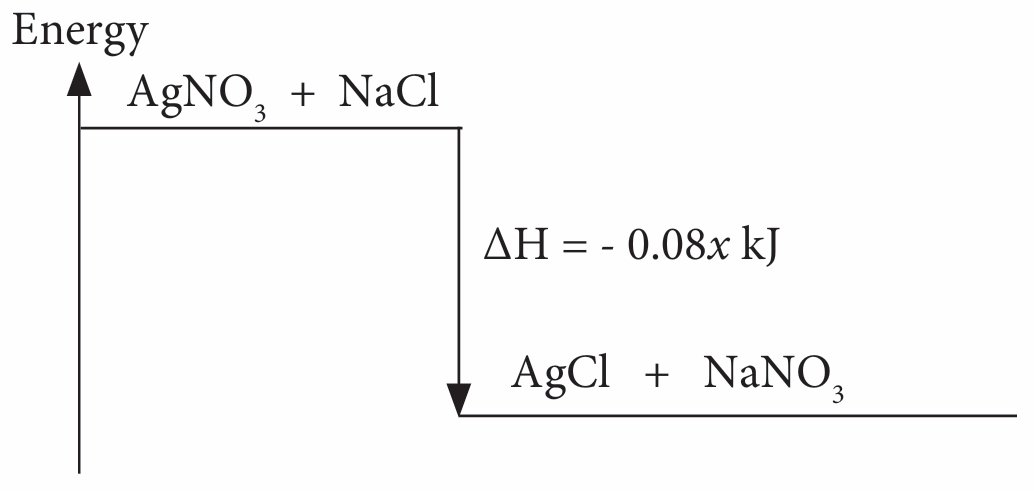
Heat of precipitation of silver chloride = – 0.08 x kJ mol−1
Note: Follow the same steps to calculate the heat of precipitation of magnesium carbonate.
3. The thermochemical equation for the heat of precipitation of silver chloride:
AgNO3 + NaCl → AgCl + NaNO3 ∆H = – 0.08 x kJ mol−1
The thermochemical equation for the heat of precipitation of magnesium carbonate:
Mg(NO3)2 + Na2CO3 → MgCO3 + 2NaNO3 ∆H = – (calculated value) kJ mol−1
4. The energy level diagram for the heat of displacement of silver chloride.
The energy level diagram for the heat of displacement of magnesium carbonate.
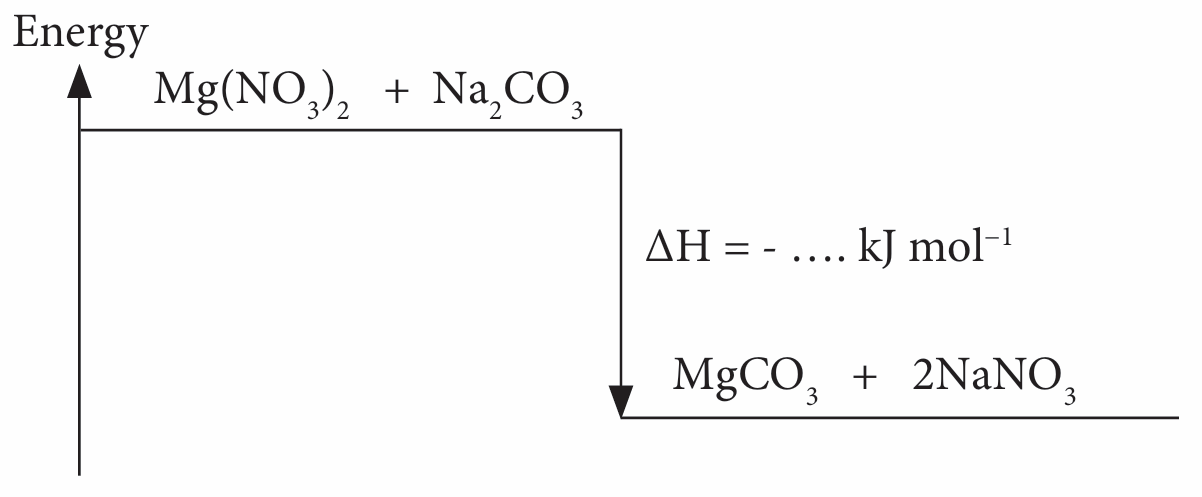
5. Different.
Difference due to:
(i) Heat is lost to the surroundings.
(ii) Polystyrene cup absorbs heat.
Aim: To determine the heat of precipitation of silver chloride, AgCl and magnesium carbonate, MgCO3.
Materials: 0.5 mol dm−3 of silver nitrate, AgNO3 solution, 0.5 mol dm−3 of sodium chloride, NaCl solution, 0.5 mol dm−3 of magnesium nitrate, Mg(NO3)2 solution and 0.5 mol dm−3 of sodium carbonate, Na2CO3 solution.
Apparatus: Two polystyrene cups with lids, measuring cylinder and thermometer.
Operational definition – Heat of Precipitation: when sodium chloride, NaCl solution is added to silver nitrate, AgNO3 solution to produce 1 mole of silver chloride, AgCl precipitate, the thermometer reading increases.
Procedure:
1. Measure 25 cm3 of 0.5 mol dm−3 of silver nitrate, AgNO3 solution and pour it into a polystyrene cup.
2. Put a thermometer into the solution and leave aside for two minutes.
3. Record the temperature of the solution.
4. Measure 25 cm3 of 0.5 mol dm−3 of sodium chloride, NaCl solution, and pour it into another polystyrene cup.
5. Put a thermometer into the solution and leave it aside for two minutes. Record the temperature of the solution.
6. Pour the sodium chloride, NaCl solution quickly and carefully into the polystyrene cup containing the silver nitrate, AgNO3 solution.

7. Cover the polystyrene cup and stir the mixture using the thermometer as shown in Figure 3.7.
8. Record the highest temperature of the mixture.
9. Repeat steps 1 to 8 by replacing silver nitrate, AgNO3 solution with magnesium nitrate, Mg(NO3)2 solution, and sodium chloride, NaCl solution with sodium carbonate, Na2CO3 solution.
Results:
Construct a suitable table to record your results and observations.
Discussion:
1. State the type of reaction that occurred.
2. Calculate the heat of precipitation of silver chloride, AgCl and magnesium carbonate, MgCO3
[Use the heat change formula, Q = mcθ]
[Given: Specific heat capacity of solution, c = 4.2 J g−1 °C−1; density of solution = 1 g cm−3]
3. Write the thermochemical equation for the precipitation of silver chloride, AgCl and magnesium carbonate, MgCO3.
4. Construct the energy level diagram for the precipitation of silver chloride, AgCl and magnesium carbonate, MgCO3.
5. The theoretical value for the heat of precipitation of silver chloride, AgCl is -65.5 kJ mol−1.
Is this value the same as the value obtained in this experiment? Explain your answer.
Conclusion:
What is the conclusion that can be drawn from this experiment?
Answer:
Result:

Discussions:
1. Double decomposition reaction (Precipitation reaction)
2. Steps in calculations:
(a) Heat of precipitation of silver chloride
(i) Calculate the number of moles or silver chloride, AgCl precipitate formed
$$ \begin{aligned} &\text { Number of moles of silver ions, } \mathrm{Ag}^{+}=\text {number of moles of silver nitrate, } \mathrm{AgNO}_3\\ &=0.5 \mathrm{~mol} \mathrm{dm} \mathrm{~m}^{-3} \times \frac{25}{1000} \mathrm{dm}^3=0.0125 \mathrm{~mol} \end{aligned} $$
$$ \begin{aligned} &\text { Number of moles of chloride ions, } \mathrm{Cl}^{-}=\text {number of moles of sodium chloride, } \mathrm{NaCl} \text { solution }\\ &=0.5 \mathrm{~mol} \mathrm{dm}^{-3} \times \frac{25}{1000} \mathrm{dm}^3=0.0125 \mathrm{~mol} \end{aligned} $$
Ionic equation: Ag+(aq) + Cl−(aq) → AgCl(s)
From the ionic equation. 1 mole of silver ions, Ag+ reacts with 1 mole of chloride ions, ,Cl− to produce 1 mole of silver chloride, AgCl.
Therefore, 0.0125 moles of silver ions, Ag+ reacts with 0.0125 moles of chloride ions, Cl− to produce 0.0125 moles of silver chloride, AgCl.
(ii) Calculate the heat change:
Mass of reacting mixture = Total volume of reacting mixture × density of solution
= (25 + 25)cm3 × 1 g cm−3 = 200 g
Change in temperature of mixture, θ = Highest temperature − lowest temperature
Heat released in the reaction Q = mcθ
= 200 g × 4.2 J g−1 °C−1 × θ
= x J
(iii) Calculate the heat change for the formation of 1 mole of precipitate
Precipitation of 0.0125 moles of silver chloride releases x J heat
Therefore, the precipitation of 1 mole of silver chloride releases
$$ \begin{aligned} & \text { = x } \mathrm{~J} \times \frac{1 \mathrm{~mol}}{0.0125 \mathrm{~mol}} \\ & =80 x \mathrm{~J} \text { heat } \\ & =0.08 x \mathrm{~kJ} \text { heat } \end{aligned} $$
(iv) Write the heat of precipitation by putting a negative sign for an exothermic reaction
Heat of precipitation of silver chloride = – 0.08 x kJ mol−1
Note: Follow the same steps to calculate the heat of precipitation of magnesium carbonate.
3. The thermochemical equation for the heat of precipitation of silver chloride:
AgNO3 + NaCl → AgCl + NaNO3 ∆H = – 0.08 x kJ mol−1
The thermochemical equation for the heat of precipitation of magnesium carbonate:
Mg(NO3)2 + Na2CO3 → MgCO3 + 2NaNO3 ∆H = – (calculated value) kJ mol−1
4. The energy level diagram for the heat of displacement of silver chloride.

The energy level diagram for the heat of displacement of magnesium carbonate.

5. Different.
Difference due to:
(i) Heat is lost to the surroundings.
(ii) Polystyrene cup absorbs heat.